



Why choose Avenir Renovations?
Why fit out or renovate a terrace in Switzerland?
Whether to create a new outdoor space or to breathe new life into an aging terrace, this type of work addresses aesthetic, practical, and property-related issues. In Switzerland, they must also take into account specific climatic constraints.
Create a functional outdoor living space
A well-designed terrace allows you to enjoy sunny days while providing a comfortable space to relax, entertain, or dine outdoors. It becomes a central place for conviviality.
Whether attached to the house, suspended, elevated, or set in the garden, the terrace adapts to all configurations.
Enhance your property value
A terrace increases the value of your home by improving its usable area and attractiveness. It is an important asset when selling or renting.
A modern, well-fitted terrace offers a strong visual impact and appeals to potential buyers.
Improve insulation and the indoor/outdoor transition
The addition of a terrace can also help better insulate certain facades while creating a harmonious transition between the interior of your home and its outdoor environment.
It contributes to the energy and aesthetic optimization of your home.
What are the steps of a terrace fit-out or renovation project?

A successful terrace project involves rigorous planning, professional execution, and smooth coordination. At Avenir Renovations, each step is overseen by a dedicated contact person, ensuring quality and adherence to deadlines.
What types of terraces can be developed?
The choice of terrace type depends on several factors: the terrain configuration, the budget, the desired style, and the intended use. We guide you towards the most relevant solution for your project.
Terraces on pedestals are ideal for leveling differences in height or preserving the waterproofing of an existing slab. They allow for quick assembly without ground fixation.
This type of terrace is compatible with various coverings such as wood, porcelain stoneware, or concrete slabs.
Wood brings warmth and elegance to your outdoor space. Species such as treated pine, ipe, or larch are particularly popular.
Composite wood offers a durable, rot-proof, and maintenance-free alternative, with an appearance very close to natural wood.
Decorative concrete is appreciated for its resistance, durability, and great finishing freedom. It allows for the creation of a homogeneous, customizable, and very aesthetic surface.
It can be poured with stone effects, smoothed, sanded, or stamped to match the style of your home.
Outdoor tiling is an elegant choice, resistant to weather conditions and easy to clean. It comes in a multitude of formats, textures, and colors.
It is particularly suitable for terraces adjacent to the house, for a harmonious continuity with indoor spaces.
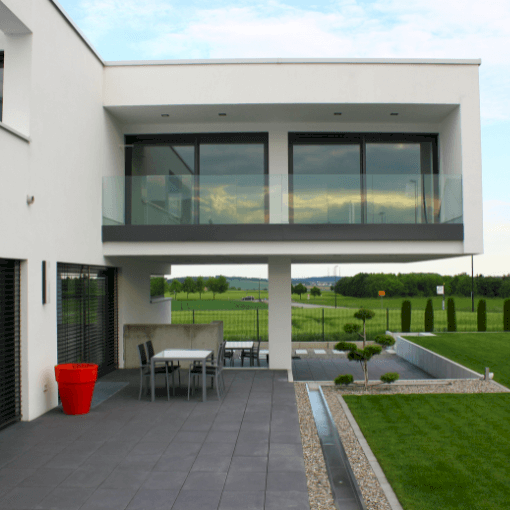
In the case of sloped terrain or multi-story buildings, a raised terrace allows for the creation of an outdoor space where it seemed impossible. It is built on an appropriate supporting structure.
These terraces offer unobstructed views and unique atmospheres, provided that safety standards are respected.
How much do terrace fit-out or renovation works cost in Switzerland?
The price of a terrace depends on its area, the material used, the complexity of the terrain, and the options chosen. Here is an estimated table based on the rates observed in Switzerland:
| Type of service | Price per m² (CHF) | Average total price (CHF) |
| Natural wood terrace (pine, larch) | 250 – 400 CHF/m² | 5'000 – 12'000 CHF |
| Composite wood terrace | 300 – 500 CHF/m² | 6'000 – 15'000 CHF |
| Porcelain stoneware or tiling terrace | 300 – 600 CHF/m² | 7'000 – 18'000 CHF |
| Decorative concrete terrace | 200 – 450 CHF/m² | 5'000 – 14'000 CHF |
| Suspended or raised terrace | 400 – 700 CHF/m² | 10'000 – 25'000 CHF |
| Pergola, guardrail, lighting | Package according to options | 3'000 – 15'000 CHF (average) |
These amounts include supply, labor, any permits, and finishes. A personalized quote allows for precise budget adjustments based on your project.
What materials for a durable terrace in Switzerland?
In Switzerland, exposure to frost, UV rays, and humidity requires robust, resistant, and easy-to-maintain materials. The choice of materials determines the durability of the terrace, its maintenance, and its visual appeal.
Wood: warmth and authenticity
Natural wood brings undeniable charm. However, it must be treated against insects, fungi, and moisture. Annual maintenance is recommended to preserve its color and integrity.
Wood is often used on suspended terraces or in landscaped gardens.
Composite wood: practicality and resistance
Made from wood fibers and resins, composite wood does not gray, crack, and requires no treatment. It withstands weather conditions and UV rays very well.
It is an excellent choice for family terraces and high-traffic areas.
Porcelain stoneware: modernity and variety
Porcelain stoneware tiles are non-slip, frost-resistant, easy to clean, and available in many patterns: wood, stone, concrete imitation...
They are compatible with pedestal systems or glued installations on screed.
Decorative concrete: durable and customizable
Concrete can be tinted, smoothed, sanded, or stamped for a modern or traditional finish. It withstands extreme weather conditions very well.
It is particularly suitable for large surfaces and ground-level terraces.
Possible additional equipment and fittings
A terrace is not limited to its surface covering. The overall fit-out also includes comfort, safety, and personalization elements that make it a true living space.
Pergola or awning for shading
A shading structure is essential for protection from the sun in summer. The pergola can be bioclimatic, fixed, or attached, while the awning can be manual or motorized.
These solutions allow for temperature regulation and extended use of the terrace throughout the year.
Guardrails and balustrades
In the case of elevated or suspended terraces, guardrails are mandatory. They ensure the safety of occupants while contributing to the overall aesthetics.
Materials vary from glass to metal, including wood or stainless steel.
Outdoor lighting
Good lighting allows for enjoying the terrace in the evening and securing movement. Recessed lights, solar bollards, or hanging fixtures can be integrated into the design.
They also enhance the surfaces and plants.
Furniture and decoration
The arrangement of furniture should adapt to the available space. Tables, loungers, fire pits, lighted pots, or planters complete the ensemble to create a warm and personalized space.
Well-chosen furniture contributes to the comfort and daily use of the terrace.
What regulations apply to terraces in Switzerland?
Before starting work, it is important to know the legal obligations specific to your municipality or canton. The rules vary depending on the type of terrace, its area, height, and location.
Building permit
A declaration or permit application is often required for elevated terraces, those attached to a building, or visible from the public road. It is less necessary for ground-level terraces under 30 m².
We help you compile the file according to local requirements.
Distances and respect for property boundaries
Municipal regulations sometimes impose minimum distances between the terrace and property lines. This aims to preserve neighbors' privacy, the aesthetics of the neighborhood, and proper water drainage.
A well-thought-out layout ensures a compliant and harmonious project.
Safety of installations
For elevated terraces, compliant guardrails are mandatory from a certain height. Outdoor lighting, electrical outlets, and anchoring of pergolas must also meet current technical standards.
We carry out a complete compliance check of your project.
FAQ – Terrace work in Switzerland
Is a permit required to build a terrace?
It depends on the nature and size of the terrace. An elevated terrace or one attached to a facade generally requires a permit. For a ground-level terrace under 30 m², a simple declaration may suffice.
What is the best material for a terrace in Switzerland?
The choice depends on your priorities: wood for its warm aesthetics, composite for its maintenance-free durability, ceramic stone for its frost resistance, or decorative concrete for its robustness.
What is the duration of work for a terrace?
Expect an average of 5 to 10 working days for a simple terrace, up to 3 weeks for a suspended terrace with pergola or guardrails. The timeline may vary depending on weather conditions and the type of materials.
Is it possible to renovate an existing terrace?
Yes, even if the structure is aging or damaged. We conduct a preliminary diagnosis to assess whether partial or complete renovation is necessary.
Can a spa, pergola, or lighting be integrated into a terrace?
Absolutely. These features can be integrated from the design stage to ensure optimal installation and compliance with Swiss standards.
Imagine your ideal terrace — Avenir Renovations makes it happen
Creating or renovating a terrace in Switzerland is much more than just a simple fit-out project: it’s about offering a new dimension to your living environment. Whether you are considering a ground-level terrace, a suspended one, made of wood, tiled, or concrete, our teams support you from A to Z with rigor and creativity.
At Avenir Renovations, we ensure comprehensive follow-up on your project, from the initial ideas to the final handover. Thanks to our local expertise and commitment to quality, we create elegant, durable terraces that are perfectly integrated into their surroundings.
Contact us for a free and personalized quote. Give your outdoor space the terrace it deserves.